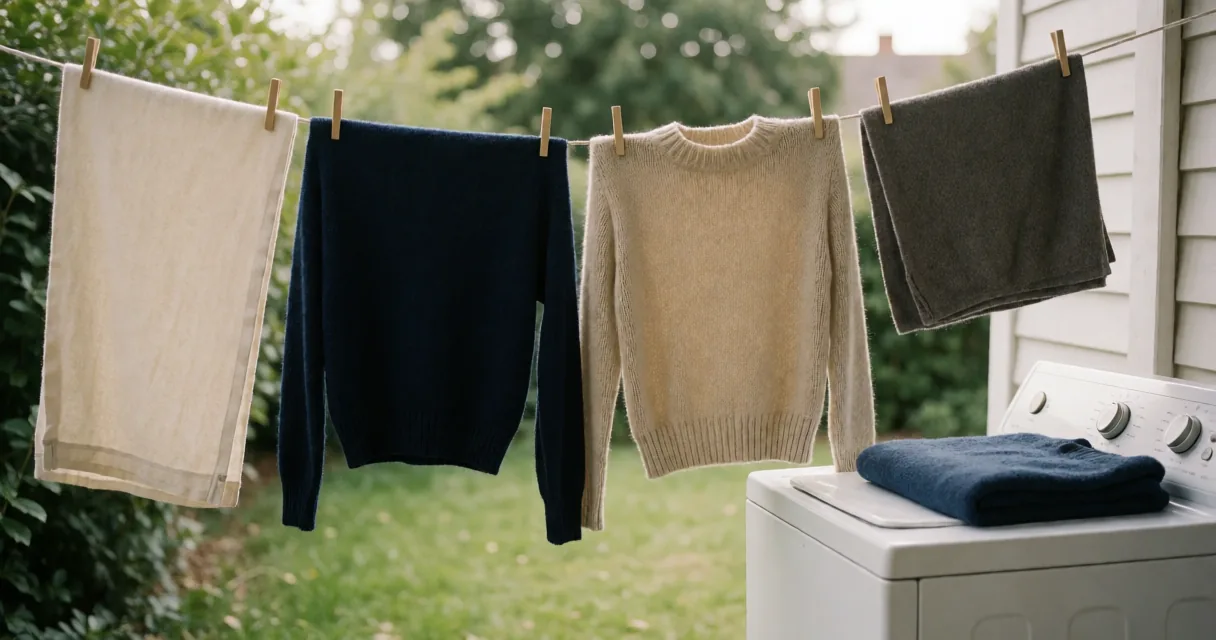
The square containing lines or a horizontal bar is not a tumble-dry symbol. According to GINETEX under ISO 3758 , the circle inside a square means tumble drying, while horizontal or vertical lines inside a square without a circle indicate a natural drying process. Once you know that distinction, the rest of the system follows a clear logic.
The core natural-drying symbols
GINETEX defines eight natural-drying symbols built from three variables: whether the garment hangs or lies flat, whether water is allowed to drip freely, and whether direct sunlight must be avoided. Here is what each combination means in practice.
Line drying (a vertical line in the square) means the garment can hang on a line or hanger. Colourfast textiles such as everyday cotton and synthetics typically carry this symbol.
Flat drying (a horizontal line in the square) means the garment should lie on a flat surface while it dries. Heavy or delicate textiles that would distort under their own wet weight need this treatment. Woolmark confirms that knitted wool in particular should be dried flat because hanging can cause the fabric to stretch lengthways and lose its shape.
Drip variants of both symbols mean the garment should be left to drip rather than spun or wrung first. A drip line or drip flat symbol is often used for large colourfast textiles or delicate items such as structured wool jackets where any additional mechanical stress could cause distortion.
Shade variants are shown by a diagonal line added to any of the above symbols. Where a shade symbol appears, the garment should be kept away from direct sun, whether outdoors or near a bright window. Silk and non-colourfast textiles often carry this marker.
Putting it together: a square containing both a horizontal line and a diagonal line means flat dry in the shade. A square with a vertical line and a diagonal line means line dry in the shade.
Why the flat-versus-hanging distinction matters
For woven garments such as tailored trousers or jackets, hanging on a hanger is usually fine. For knitwear, the picture is different. Woolmark advises placing knitwear on a pale or lint-free towel, gently reshaping it by hand, and allowing it to dry in still air. Mesh drying screens that sit over a bath can assist airflow from underneath. If you use pins to hold a garment in shape, they should be rust-proof. The principle applies indoors and outdoors: it is the position of the garment, not the location, that protects its shape.
What the shade instruction is actually protecting
The shade symbol is not primarily about drying speed. It is a colourfastness instruction. Certain dyes, particularly on silk and some synthetic blends, can fade or shift in tone under prolonged ultraviolet exposure. On autumn days in the UK, direct sun is often weak, but on bright spells it can still be sufficient to affect sensitive dyes over time. When a shade symbol is present, choosing a spot under a roof overhang, using an indoor rack near an open window, or simply turning the garment inside out are all reasonable approaches. For guidance on making the most of outdoor conditions on lower-light days, see our article on autumn outdoor drying .
When no tumble-dry symbol appears at all
GINETEX notes that in the absence of a tumble-dry symbol, the washing and ironing symbols together give indirect guidance: the more sensitive the permitted wash treatment, the more caution is warranted for drying. A garment labelled for a very mild wash cycle with no tumble-dry symbol at all should be treated as if tumble drying is not permitted, and a flat or drip-dry approach is sensible. A crossed-out tumble-dry square makes the restriction explicit, but its absence from a label is still meaningful context.
Reading the label before you wash, not after
Checking the care label before a garment goes into the machine lets you plan where it will dry. Knitwear that needs flat drying requires surface space rather than line space, which affects how you organise a drying session. If you are working out how to handle a mixed load containing both flat-dry and line-dry items, our guide on sorting a mixed autumn laundry load covers how to separate garments sensibly before washing. For setting up the right drying space indoors, choosing a rack that fits your space is a practical next step once you know what the label permits.