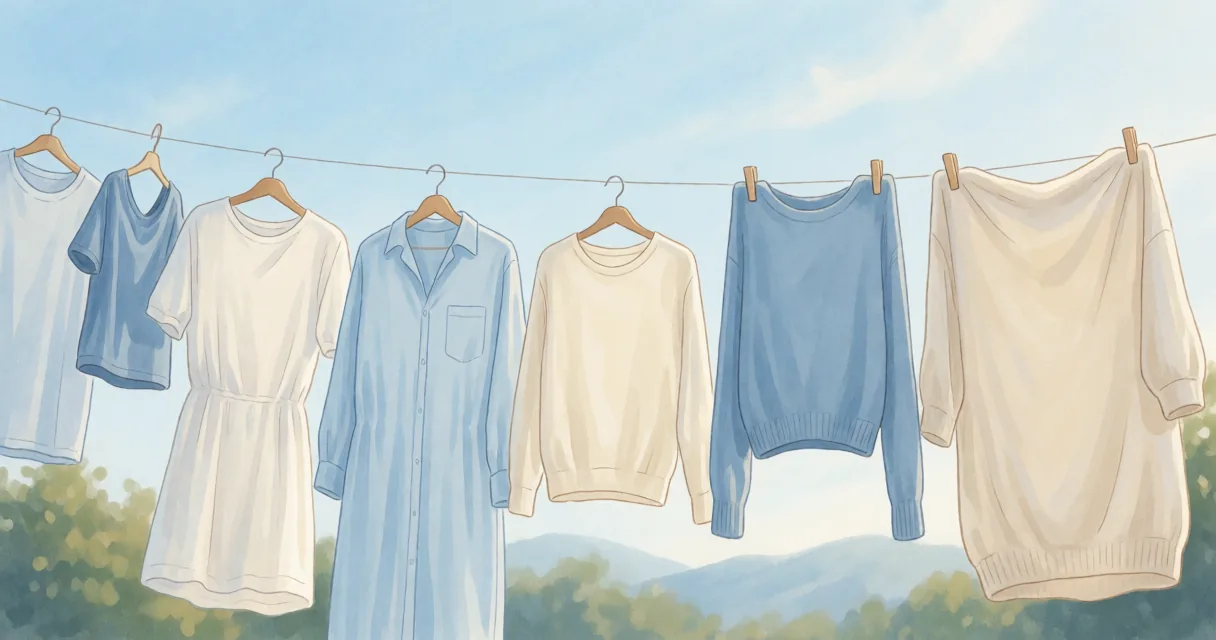
Lay your wool jumper flat to dry, reshaping it by hand while it is still damp. That single step does more to protect a knitwear garment than any choice of indoor versus outdoor location.
Why flat drying matters for wool knitwear
When a knitted wool garment is hung on a line or hanger, the weight of the water it holds pulls the fabric downward. According to Woolmark , this causes the garment to grow in length and lose its shape, sometimes permanently. Flat drying removes that gravitational stress entirely.
Woolmark notes that wovenwear such as tailored suit pants or jackets can be hung on a hanger to dry, but knitwear needs a flat surface. The source does not explain why; that distinction is simply what the care guidance states.
Before you place the garment down, gently knead it back to its original dimensions with your hands. Remove folds and creases at this stage, because they are harder to deal with once the fabric has dried. A pale or white lint-free towel makes a suitable surface. Woolmark also mentions mesh garment-drying screens designed to sit over a bath, noting they tend to speed up the drying process, though no measured evidence is given for that claim.
Reading the care label before you start
Not all wool garments dry the same way. Before you commit to a method, check the sewn-in care label. According to the GINETEX care symbol system , the natural drying symbols use a square containing horizontal or vertical lines to indicate the drying process, including flat drying and line drying. An oblique line within the square symbolises that the drying process should be carried out in the shade. A circle inside the square refers to tumble drying; if that symbol is absent or crossed out, tumble drying is not recommended.
Some Woolmark-approved garments carry a care claim explicitly permitting tumble drying on a low heat or delicates setting, but unless your label states this, flat air drying is the safer default. When in doubt, follow the label rather than a general rule.
Choosing a spot: outdoors in autumn
On a dry autumn day, outdoor drying is worth considering, but wool’s flat-drying requirement changes the practicalities. You cannot drape a knitwear garment over a washing line without risking distortion, so you need a flat mesh screen or a rack with a broad horizontal surface that allows the garment to lie supported rather than hang.
Conditions that favour outdoor drying include low relative humidity and reasonable air movement. As the Met Office explains , relative humidity indicates how close the air is to being saturated with water vapour at a given temperature; when it is high, evaporation slows because the air has less capacity to absorb additional moisture. Autumn days vary considerably, and a bright, breezy afternoon may offer useful drying conditions while a damp, still morning may not. If you are in the UK, check actual conditions rather than assuming the season dictates the weather.
Woolmark advises keeping wool garments out of direct sunlight and away from magnified sunlight near glass during drying, as these can affect colour. A shaded spot with good airflow is preferable to a sunny surface.
For more on how to read outdoor conditions in autumn, see our guide to autumn outdoor drying and wind .
Drying indoors
Indoors is often the more practical choice for a flat-drying wool garment, and it avoids the sunlight risk entirely. Place the garment on a towel on a table, a flat rack surface, or a mesh screen. A room with reasonable air movement will help; a still, closed space slows evaporation.
Avoid placing the garment over a radiator. Woolmark specifically warns that the part of a garment folded across the top of a radiator dries faster than the rest and can cause colour change or localised damage to the garment in that area.
If you are managing indoor humidity alongside drying, the indoor autumn drying guide covers the room conditions worth checking.
Flip the garment partway through
Because the garment is lying flat, the underside dries more slowly than the surface facing the air. Turning it over once during drying, and reshaping it gently at that point if needed, is a practical step that may help both sides dry more evenly and reduce the chance of the towel beneath becoming saturated. This is a suggestion rather than a guaranteed outcome, but it costs nothing to try.
For deciding which type of rack suits flat drying in your space, the rack selection guide covers formats worth considering.